


OUR FUNDED PROJECTS

About the project

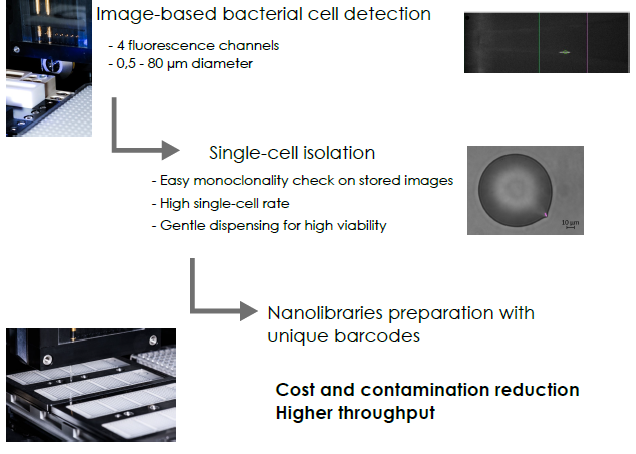
Cellenion and ECOBIO laboratory (UMR CNRS-University of Rennes) have received a Labcom-2020 €360k grant by the French National Research Agency (ANR) for the creation of the joint MICROSCALE-Lab (MICRObial Single Cell AnaLysEs Laboratory). The overall objective of this 5-year project is to offer a complete solution for the isolation, library preparation and bioinformatic analysis of single microbial cells, creating a conceptual and technological breakthrough for the study of microbial communities.

MICROSCALE-lab will benefit from the partnership between the ECOBIO laboratory, an expert in microbial ecology and environmental genomics, and Cellenion, specialists in single cell isolation solutions and molecular biology, making use of their respective infrastructures, skills and expertise. Based on the strength of this partnership between ECOBIO and Cellenion, MICROSCALE-Lab will target the growing industrial single cell market in various fields such as health, environment, bioproduction, agrifood and cosmetics, with extensive possibilities to generate new data on microbiota and their functions.

The Theory

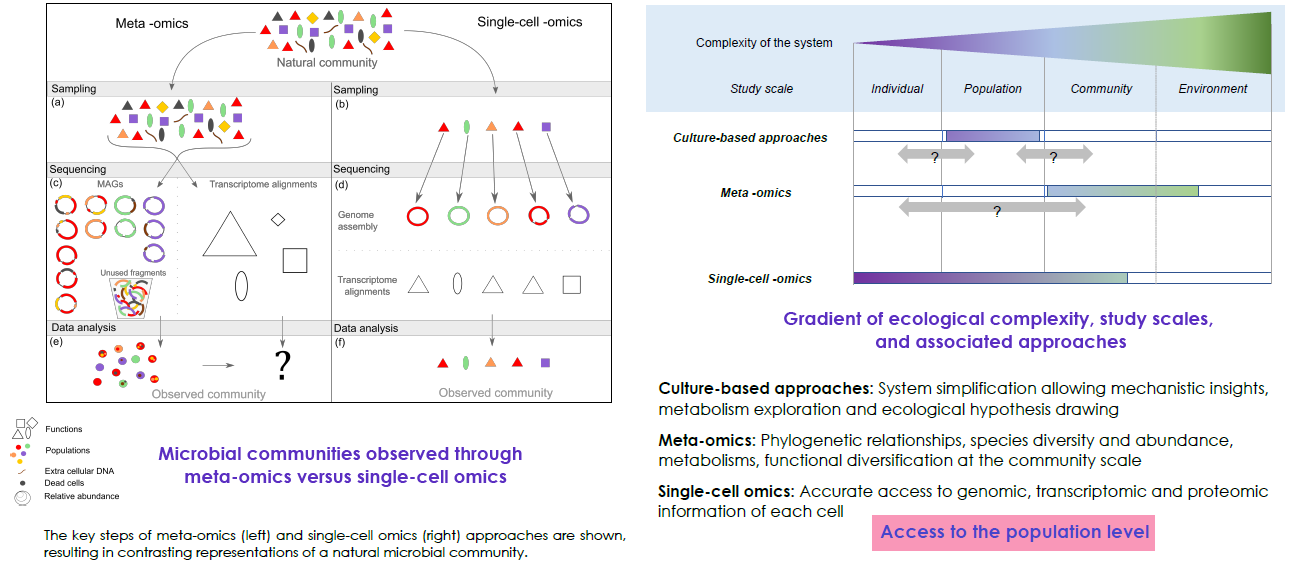
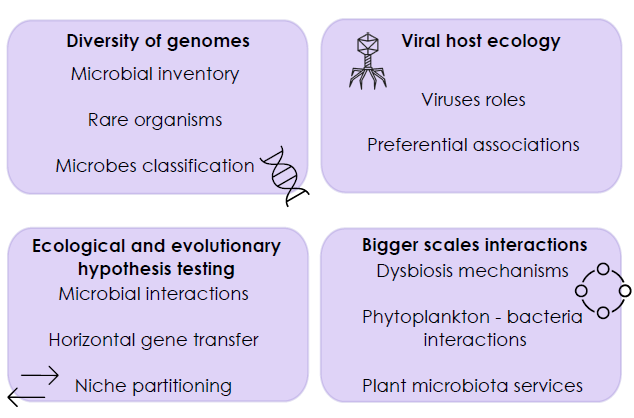
Microbial cells are metabolic units involved in complex metabolic networks at all ecological scales. Therefore, accessing the genetic and metabolic information of microbes is necessary to understand ecosystem functioning. Microbial populations present genotypic and phenotypic diversity and are, therefore, a key to understanding genetic structure, haplotype fitness, and the dynamics of ecological interactions.

Applications in microbial ecology – scDNA-seq / scRNA-seq

cellenONE technology

Perspectives

Single-cell omics applied to micro-organisms could become a gold standard in microbial ecology. A knowledge upshot is
expected in microbial interactions and eco-evolutionary boundaries through the enabling of mechanistic characterization
of populations and community assembly processes. Currently, the use of meta-omics and single-cell omics on the same
sample appears to be the best option, combining the strengths of the two approaches: (i) high throughput and alpha/beta
diversity and (ii) fine-scale analysis by scWGS and/or scRNAseq.

Mauger, S., Monard, C., Thion, C., & Vandenkoornhuyse, P. (2021).
Contribution of single-cell omics to microbial ecology. Trends in Ecology & Evolution.