PRODUCTS – CONSUMABLES
proteoCHIP Product Range
proteoCHIP®: Scalable, Loss-Minimized Sample Preparation for Single-Cell Proteomics
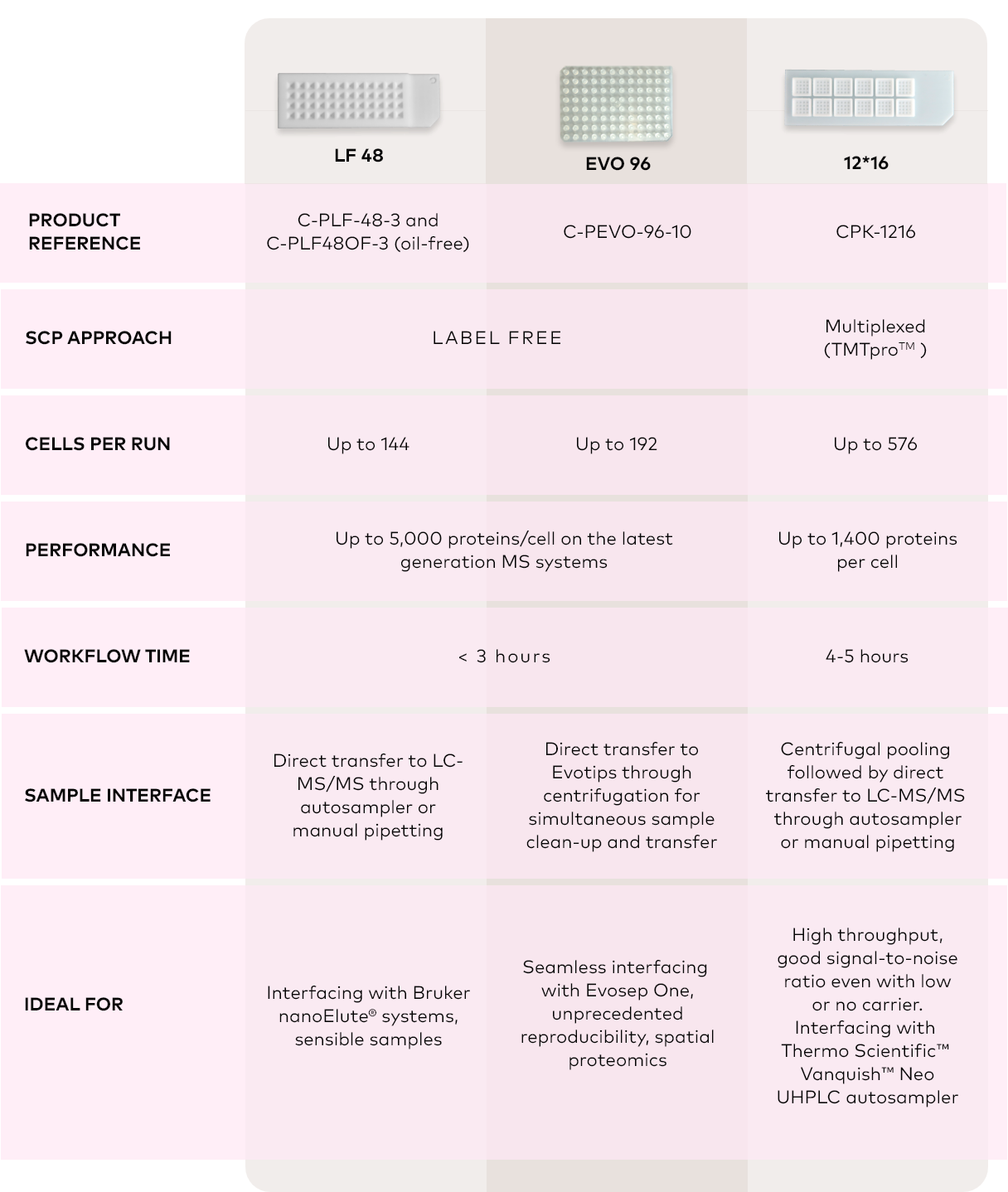
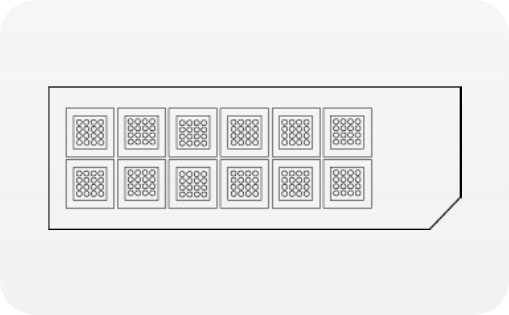
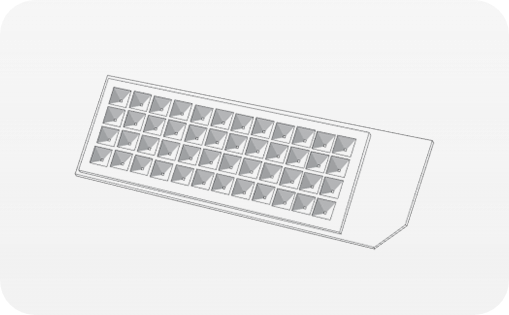
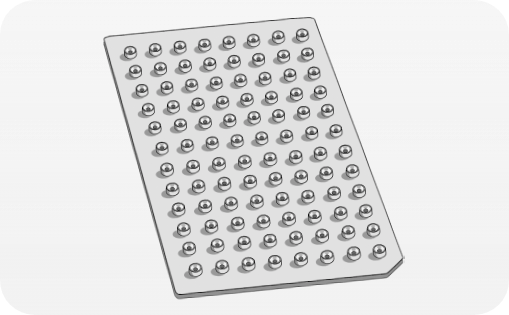
Single-cell proteomics demands workflows that are fast, reproducible, and extremely sensitive. proteoCHIP® consumables (LF 48, EVO 96 and 12*16), are designed to meet this challenge by miniaturizing reactions, reducing manual handling, and ensuring seamless integration with cellenONE® single cell dispensers. Whether label-free or multiplexed, all proteoCHIP® formats deliver low-loss sample transfer and full sample preparation workflow for direct interfacing with LC-MS systems. The result: robust, automated preparation that maximizes proteome coverage while conserving precious samples, making single-cell proteomics more accessible and reproducible than ever.
You're in good company
These leading institutions use our single cell and 3D cell model technologies:










EXPLORE THE FULL PRODUCT RANGE
Benefits
All proteoCHIP formats enable nanoliter-scale volume reactions, dramatically reducing sample and reagent use while enhancing sensitivity.
Designed to work with the cellenONE® platform for image-based single-cell isolation and picoliter/nanoliter dispensing, enabling automation and consistency, from single cell isolation to samples ready for LC-MS.
All chips reduce manual handling, vial exchanges, and human error by supporting direct processing and centrifugation-based pooling and loading, enhancing reproducibility and reducing losses.
Each format enables seamless interfacing with autosamplers, allowing ‘lossless’ transfer of peptides into mass spectrometry platforms.
All support parallel processing: LF48 handles 48 wells x3 chips (144 cells), 12*16 handles up to 576 cells, and EVO 96 processes 192 samples per run.
End-to-end sample prep is fast (EVO 96 completes in <3 hours), scalable, and consistent: critical for high-impact, reproducible single-cell proteomics.
“Our workflow sets a benchmark in SCP for sensitivity and throughput, with broad applications in basic biology and biomedicine for identification of cell type-specific markers and therapeutic targets.” Ye, Z., Sabatier, P., van der Hoeven, L. et al. Nature Methods 22, 499–509 (2025)

Validated on
proteoCHIP EVO 96
WORKFLOW

Which proteo CHIP should I choose for my experiment?